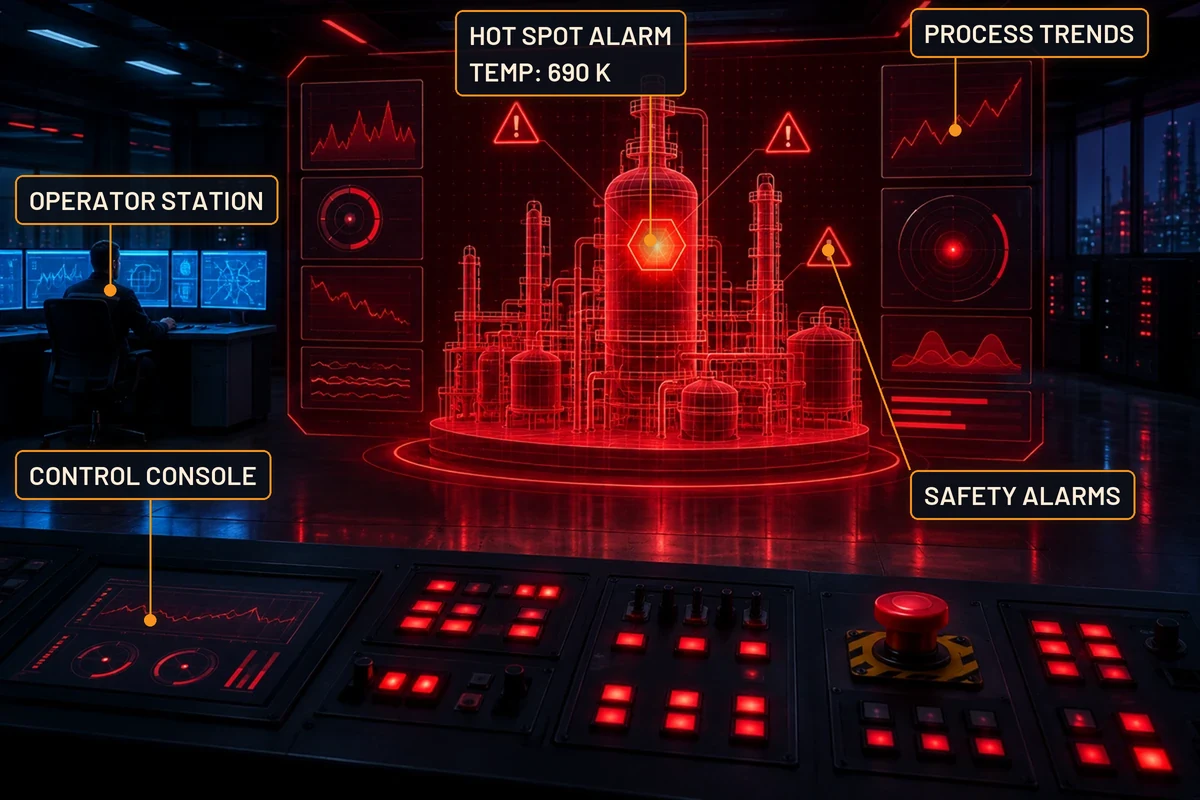
DIFREX reactor emergency response is rapid engineering support for an operating reactor that has moved outside safe or profitable limits. We remain ready for immediate response to reactor emergencies, diagnose the root cause, and recommend both the immediate measure that brings your unit back under control and the lasting solution that keeps it there.
Support is available on-site or remotely, worldwide, for fixed-bed, fluidized-bed, moving-bed, quench, microchannel, CSTR and tubular reactors, catalytic and non-catalytic, across refining, petrochemicals, chemicals, energy, coal and biomass conversion, minerals and emerging net-zero technologies.
Most reactor emergencies show up as one of these symptoms. Each one has a physical or chemical cause that can be identified and fixed.
From past experience, most plant reactor problems are resolved within 1–3 days once we are on-site or receive a clear problem definition, provided the problem is not caused by a fundamental flaw in the original design.
Always follow your plant’s own emergency shutdown and safety procedures first. DIFREX provides engineering diagnosis and solutions; we do not replace your site emergency response team or local emergency services.
Once the unit is safe, contact DIFREX with the information listed here and we will start on the diagnosis right away.
DIFREX is founded and led by Subhash Dutta, Ph.D., a reactor engineer with more than 35 years of industrial and academic experience, including the commercialization of 4 new technologies and commercial fixed-bed, fluidized-bed and quench reactor systems.
We have fixed problems like these in operating plants before. In one case, effluent line plugging from product polymerization continued despite every operational control; we traced it to an under-designed heat exchanger that let the reactor temperature run away. Knowing whether a problem can be fixed by operation or needs a design change is what saves days of lost production.
Reactor emergency response is rapid engineering support for an operating reactor that has moved outside safe or profitable limits, such as a temperature runaway, plugging, defluidization, pressure build-up or a sudden loss of yield. DIFREX diagnoses the root cause and recommends immediate corrective measures and a lasting fix.
DIFREX responds to temperature runaway and hot spots, effluent line plugging and fouling, pressure-drop build-up, catalyst deactivation, defluidization and agglomeration in fluidized beds, off-spec product and sudden loss of conversion or selectivity, in fixed-bed, fluidized-bed, moving-bed, quench, microchannel, CSTR and tubular reactors.
From past experience, most plant reactor problems are resolved within 1 to 3 days once DIFREX is on-site or receives a clear problem definition directly from the operating team, provided the problem is not caused by a fundamental flaw in the original design.
Both. DIFREX supports plants worldwide, either remotely from operating data and a clear problem description, or on-site with the operating team when the situation requires it.
Send a short description of the symptoms and when they started, recent trends of temperatures, pressures and flows, feed and product analyses, any recent change in feedstock, catalyst or operating conditions, the reactor type and a process flow diagram, and the actions already taken.
If the root cause is a fundamental design limitation, such as an under-designed heat exchanger that cannot remove the heat of reaction, operating adjustments alone will not fix it. DIFREX then recommends a retrofit or revamp, with an estimate of cost and return, through its de-bottlenecking, retrofit and revamp service.
Follow your plant's own emergency shutdown and safety procedures first. Once the unit is safe, contact DIFREX with the operating data for diagnosis. DIFREX provides engineering diagnosis and solutions; it does not replace your site emergency response team or local emergency services.