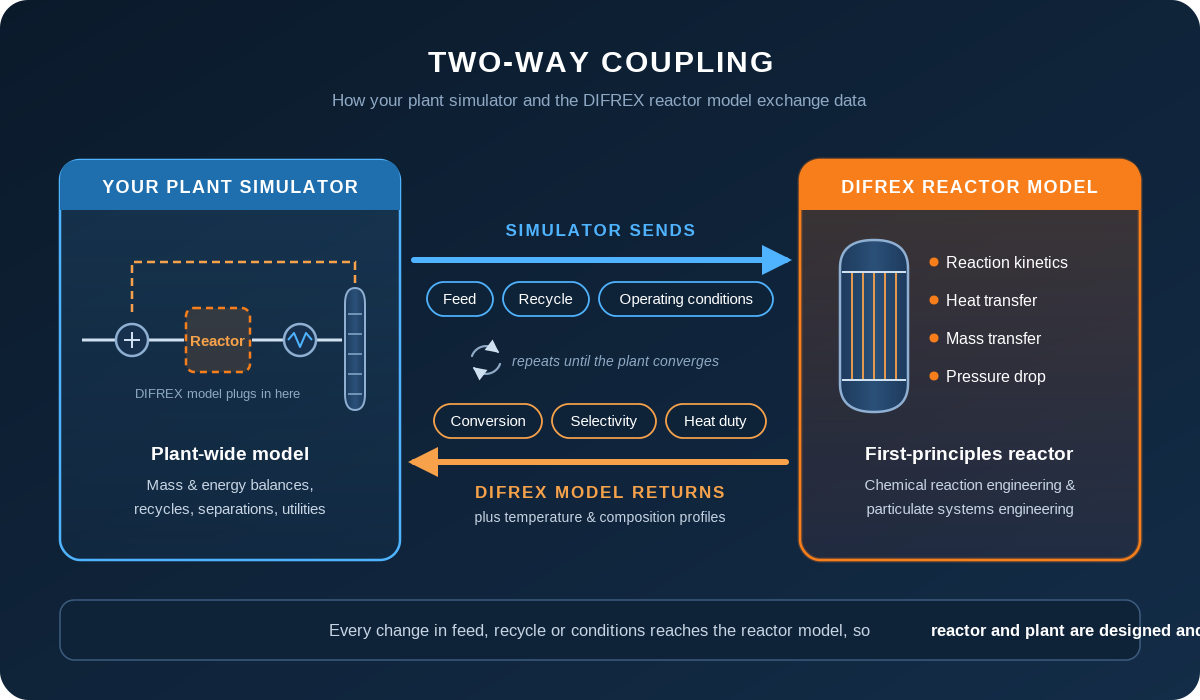
DIFREX model integration places a rigorous reactor model inside your plant simulation model. We help you integrate our model with your plant simulation model, so the reactor responds correctly to every change in feed, recycle and operating conditions, and the reactor and the rest of the plant can be designed and optimized together.
Your simulator remains the plant-wide model. DIFREX supplies the reactor model that sits inside it, built on first principles of chemical reaction engineering and particulate systems engineering.
The reactor sets the yield, the recycle load and the heat balance of the whole plant, yet most plant models represent it with the simplest block available.
The DIFREX team has hands-on experience with process simulators such as Aspen Plus, Aspen HYSYS and gPROMS. DIFREX reactor models and the Tech Suite platform complement conventional plant simulators rather than replace them.
Fixed-bed, fluidized-bed (bubbling, turbulent and circulating), moving-bed, quench, microchannel, CSTR and tubular reactors, catalytic and non-catalytic, across refining, petrochemicals, chemicals, energy, coal and biomass conversion and minerals processing.
Reactor model integration means placing a rigorous reactor model inside your plant simulation model, in place of a simplified reactor block, so the reactor's conversion, selectivity and heat release respond correctly to changes in feed, recycle and operating conditions across the whole flowsheet.
Standard reactor blocks usually assume a fixed conversion or yield, chemical equilibrium, or an ideal plug-flow or stirred-tank reactor. They do not capture hydrodynamics, heat and mass transfer limits, catalyst deactivation or solids behavior, so the plant model can give misleading results when conditions move away from the base case.
No. DIFREX reactor models and the Tech Suite platform complement conventional process plant simulators rather than replace them. Your simulator stays the plant-wide model; DIFREX supplies the reactor model that sits inside it.
The DIFREX team has hands-on experience with process simulators such as Aspen Plus, Aspen HYSYS and gPROMS. The integration approach is chosen to suit your simulator and how the combined model will be used.
Fixed-bed, fluidized-bed (bubbling, turbulent and circulating), moving-bed, quench, microchannel, CSTR and tubular reactors, for catalytic and non-catalytic reactions, including non-stoichiometric systems found in refining and coal or biomass conversion. Unconventional systems can be covered with a custom model.
Your current plant simulation model or flowsheet, the reactor design and operating data, feed and product analyses, any available kinetic, pilot or plant data, and the questions the integrated model must answer, such as debottlenecking, optimization or a new feedstock.
Ready to connect your reactor and plant models? Contact DIFREX.