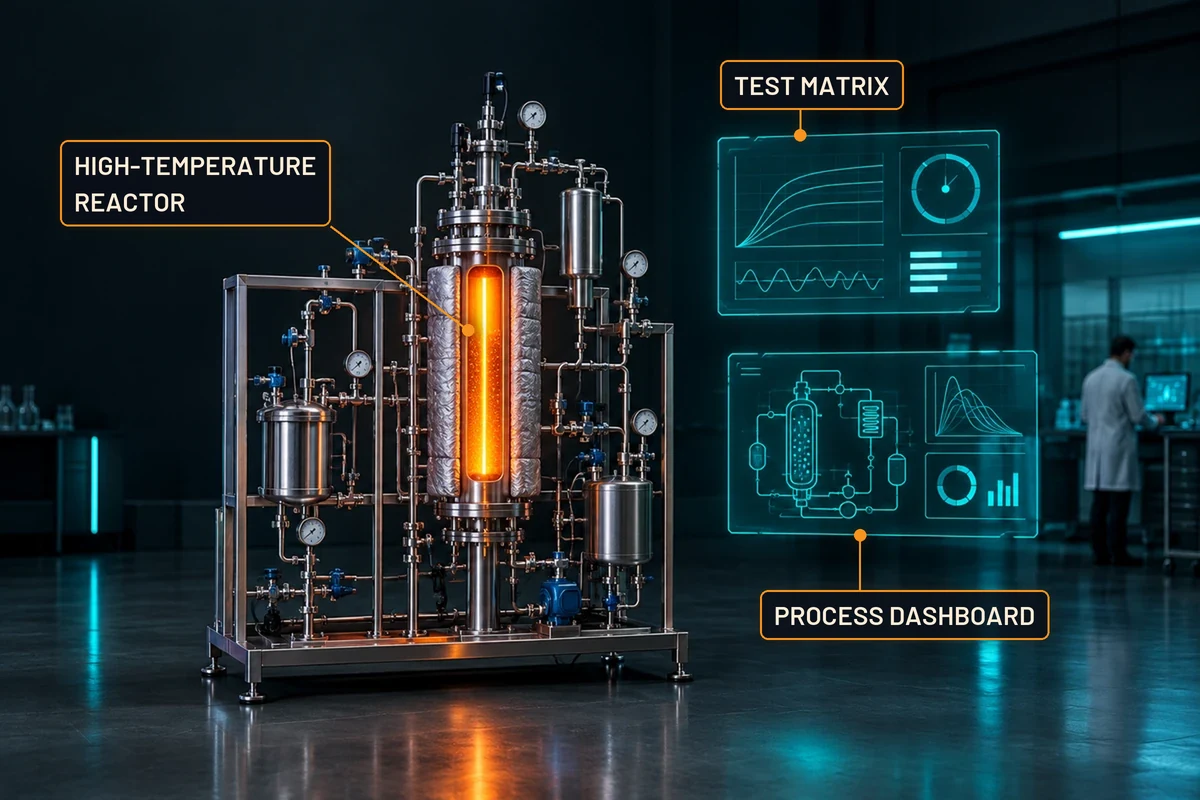
A DIFREX non-catalytic bench test or pilot plant campaign is a planned series of small-scale experiments on a process where the solids themselves react, such as gasification, pyrolysis, combustion or roasting. We design the unit, set the experimental plan and test matrix, and execute the campaign, so that you get the data needed for reliable kinetics, a reactor model and a confident scale-up to the commercial unit.
Processes in which solids take part in both chemical and physical transformations, in moving, bubbling, circulating, entrained and fixed beds.
In a catalytic test the solid stays essentially the same while the gas reacts on it. In a non-catalytic process the solid is consumed or transformed as it reacts, so the campaign has to measure how the solid changes, not only what leaves the reactor. A useful test program tracks:
We design, build and/or operate your bench or pilot-scale unit. It is set up to mimic the dominating kinetic, heat and mass transfer and hydrodynamic features and the expected operating window of the commercial unit, to the extent possible.
Campaigns can generate more data than needed, or the wrong data. We recommend a test matrix that collects the data most useful for establishing reaction mechanism and kinetics, developing the reactor model and scaling up.
We run or support the campaign and turn the results into reaction kinetics, a reactor model and scale-up projections that fill any gap between the test unit and the commercial reactor.
We use a ‘forward’ instead of a ‘back-and-forth’ approach to avoid surprises and delays in reactor scale-up. Planning each stage with the commercial unit in view minimizes the uncertainty, cost and time of successive steps: bench → pilot → demo → commercial unit. Our standardized procedures shorten this path further.
DIFREX founder Subhash Dutta, Ph.D. has published peer-reviewed research on coal and char reaction kinetics and co-authored the chapter “Kinetics of Coal Pyrolysis and Gasification Reactions” in Coal Conversion Technology (Addison-Wesley, 1979, with C. Y. Wen). See also our non-catalytic gas-solid reactor design and the catalytic bench test pages.
It is a planned series of small-scale experiments on a process where the solids themselves react, such as gasification, pyrolysis, combustion or roasting, rather than acting as a catalyst. The campaign produces the data needed to establish reaction kinetics, build a reactor model and scale the process up to a commercial unit.
In a non-catalytic process the solids are consumed or transformed as they react: their size, porosity, density and composition change, ash or product layers form, and particles can shrink, break up or agglomerate. Tests must therefore track solid conversion over time and these physical changes, not just gas-phase conversion over a stable catalyst.
Combustion and incineration, gasification and pyrolysis of biomass, sludge, coal and other solid fuels, roasting and calcination of minerals, and sorbent-based desulfurization and mercury removal, including regenerative absorber-desorber (dual-bed) systems.
DIFREX can design, build and/or operate your bench or pilot-scale unit, recommend the experimental plan and test matrix, execute or support the campaign, and turn the results into reaction kinetics, a reactor model and scale-up projections for the commercial design.
Experimental campaigns can generate more data than needed, or the wrong data. A focused test matrix collects the data most useful for establishing reaction mechanism and kinetics, developing the reactor model and scaling up, which saves time and cost.
DIFREX designs and operates bench and pilot units to mimic the dominating kinetic, heat and mass transfer and hydrodynamic features of the commercial unit as far as possible, and fills any gap with scale-up model projections. This ‘forward’ approach avoids back-and-forth iterations across the bench, pilot, demonstration and commercial steps.
Planning a non-catalytic test campaign? Contact DIFREX.