
...environment/ CO2/ PTF, energy, coal/ biomass, catalysts, chemicals, petrochemicals, minerals
...environment/ CO2/ PTF, energy, coal/ biomass, catalysts, chemicals, petrochemicals, minerals
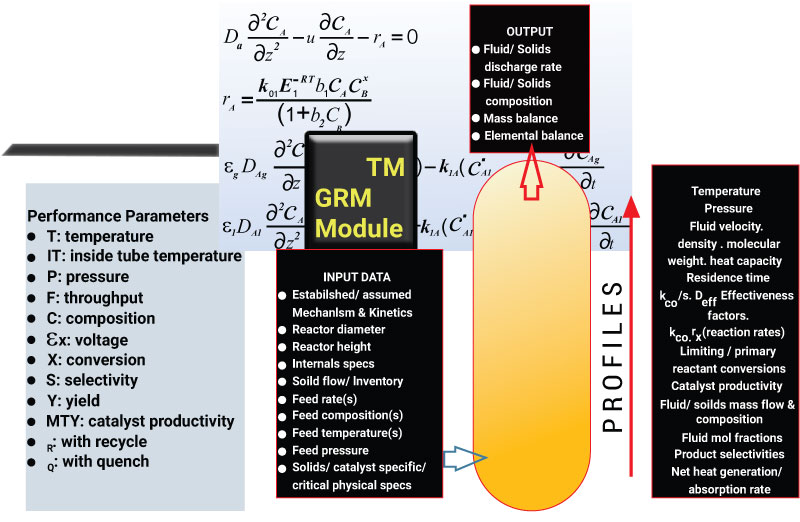 User-Ready Modules: Each user-ready reactor design module or the total package
(GRMTM) is a stand-alone and user-friendly program for you to carry
and use wherever you are and whenever you want. It provides you prompt, reliable and
quantitative answers regarding not only your final reactor design and commercial projections,
but also almost all key and what-if questions at each step from concept to commercialization
that includes technical and economic feasibility studies, experimental unit (bench and/or pilot)
design, experimental plan and procedure development, critical data analysis, data screening,
establishing intrinsic reaction mechanism and kinetics, catalyst formulation, screening and
size/ shape selection (if used), process engineering, interaction with EPC company, reactor
fabricator and project team, and development of right and safe operational (including startup &
shutdown) and control procedures.
User-Ready Modules: Each user-ready reactor design module or the total package
(GRMTM) is a stand-alone and user-friendly program for you to carry
and use wherever you are and whenever you want. It provides you prompt, reliable and
quantitative answers regarding not only your final reactor design and commercial projections,
but also almost all key and what-if questions at each step from concept to commercialization
that includes technical and economic feasibility studies, experimental unit (bench and/or pilot)
design, experimental plan and procedure development, critical data analysis, data screening,
establishing intrinsic reaction mechanism and kinetics, catalyst formulation, screening and
size/ shape selection (if used), process engineering, interaction with EPC company, reactor
fabricator and project team, and development of right and safe operational (including startup &
shutdown) and control procedures.
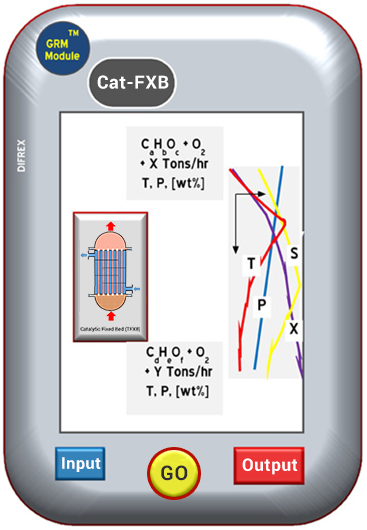 Catalytic Fixed Bed Reactor (Cat-FXB): This module is applicable to
three operational modes of this reactor: isothermal, adiabatic and
non-adiabatic. The isothermal mode (with imposed temperature profile) is very
useful for establishing reaction mechanism and kinetics from data generated in an integral
tubular reactor with measured axial temperature profile. The adiabatic mode is representative of
a single packed bed or multiple packed beds with inter-bed cooling. The Nonadiabatic
mode represents a or other heat transfer fluid, like smother so its cooled multi-tubular
fixed bed reactor that is most common in the industry. Accurate predictions of reactor
axial temperature profile and the temperature peak for an exothermic reaction are two key
requirements of this model for the adiabatic and Nonadiabatic operating modes of this reactor.
For a given reaction system and operating conditions the temperature profile and the peak are
functions of the effective particle size of the catalyst packing and the tube diameter for a
Multitubular reactor in addition to rates of reactions and heat generation. Determination of the peak temperature and its control is
critical to minimize hot spots and potential temperature runaway that is a key concern
in the design of this reactor.
Catalytic Fixed Bed Reactor (Cat-FXB): This module is applicable to
three operational modes of this reactor: isothermal, adiabatic and
non-adiabatic. The isothermal mode (with imposed temperature profile) is very
useful for establishing reaction mechanism and kinetics from data generated in an integral
tubular reactor with measured axial temperature profile. The adiabatic mode is representative of
a single packed bed or multiple packed beds with inter-bed cooling. The Nonadiabatic
mode represents a or other heat transfer fluid, like smother so its cooled multi-tubular
fixed bed reactor that is most common in the industry. Accurate predictions of reactor
axial temperature profile and the temperature peak for an exothermic reaction are two key
requirements of this model for the adiabatic and Nonadiabatic operating modes of this reactor.
For a given reaction system and operating conditions the temperature profile and the peak are
functions of the effective particle size of the catalyst packing and the tube diameter for a
Multitubular reactor in addition to rates of reactions and heat generation. Determination of the peak temperature and its control is
critical to minimize hot spots and potential temperature runaway that is a key concern
in the design of this reactor.
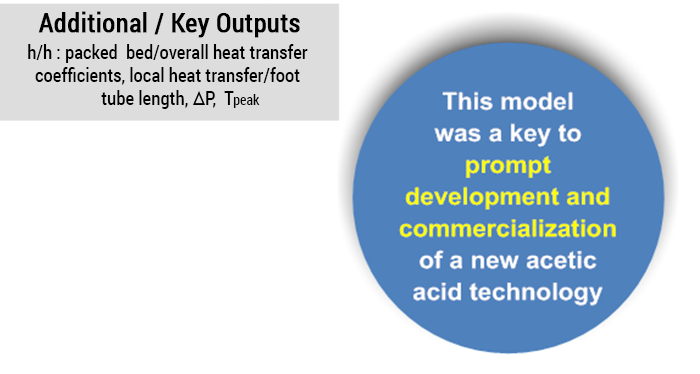
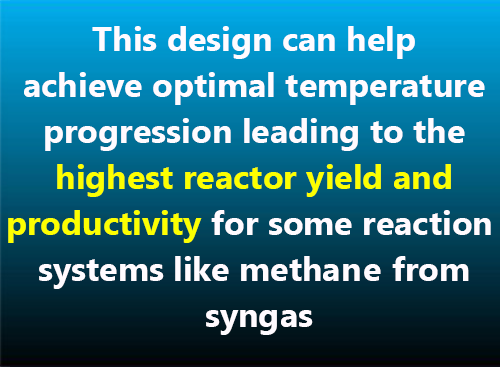
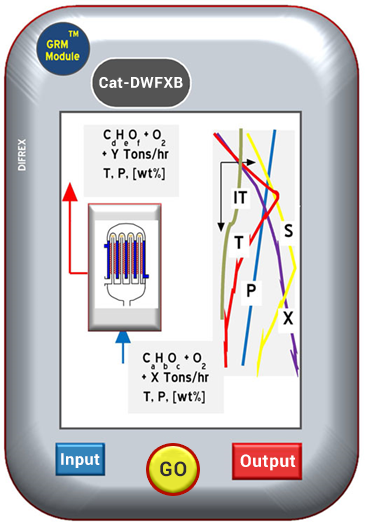 Catalytic Double-Wall Fixed Bed Reactor (Cat-DWFXB): In a catalytic double-wall
fixed bed reactor (also known as bayonet-tube reactor) a donut-shaped or annular catalyst bed is
cooled by both the feed gas flowing through an inner tube (forming the donut hole) and the steam
or other Heat transfer flow surrounding the outer wall of the bayonet tube. This is the
configuration used in so-called ‘super-converter’ for methanol synthesis. An optimal
axial temperature progression leading to maximum methanol yield (due to close approach
to equilibrium conversion and selectivity) and productivity is achievable through this
design. The module offered for this reactor configuration was
developed based on rigorous simulation of published data on optimal temperature and
conversion profiles of a methanol super-converter reactor. Such a reactor
could be considered for other reaction systems as well.
Catalytic Double-Wall Fixed Bed Reactor (Cat-DWFXB): In a catalytic double-wall
fixed bed reactor (also known as bayonet-tube reactor) a donut-shaped or annular catalyst bed is
cooled by both the feed gas flowing through an inner tube (forming the donut hole) and the steam
or other Heat transfer flow surrounding the outer wall of the bayonet tube. This is the
configuration used in so-called ‘super-converter’ for methanol synthesis. An optimal
axial temperature progression leading to maximum methanol yield (due to close approach
to equilibrium conversion and selectivity) and productivity is achievable through this
design. The module offered for this reactor configuration was
developed based on rigorous simulation of published data on optimal temperature and
conversion profiles of a methanol super-converter reactor. Such a reactor
could be considered for other reaction systems as well.
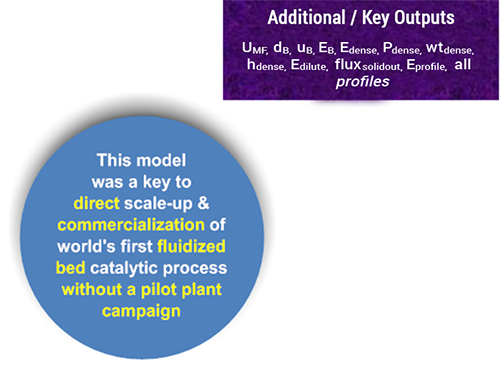
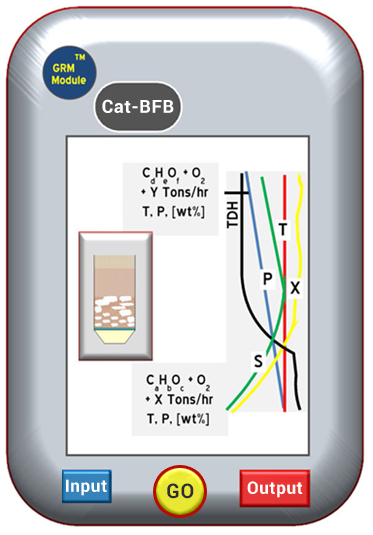 Catalytic Bubbling/Turbulent Fluidized Bed Reactor (Cat-BFB): This model is
based on rigorous and iterative calculations of mass transfer rates between void/bubble, cloud
and emulsion phases of a bubbling/turbulent fluidized bed reactor along the entire dense bed
height. It accounts for reactions and mass transfer
in five distinct hydrodynamic zones: grid (gas distributor) or void/bubble growth zone,
bubbling turbulent zone, splash zone, TDH (transport disengaging height) zone and
post-TDH zone.
Catalytic Bubbling/Turbulent Fluidized Bed Reactor (Cat-BFB): This model is
based on rigorous and iterative calculations of mass transfer rates between void/bubble, cloud
and emulsion phases of a bubbling/turbulent fluidized bed reactor along the entire dense bed
height. It accounts for reactions and mass transfer
in five distinct hydrodynamic zones: grid (gas distributor) or void/bubble growth zone,
bubbling turbulent zone, splash zone, TDH (transport disengaging height) zone and
post-TDH zone.
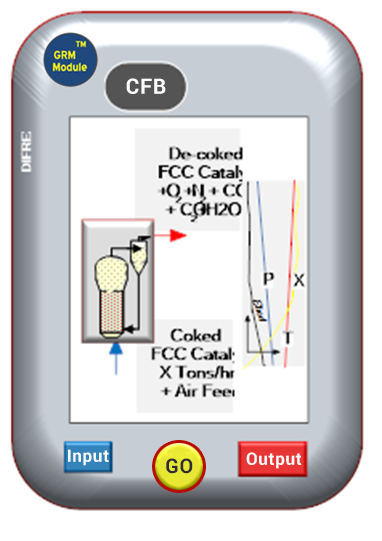 Circulating/Fast Fluidized Bed Reactor (CFB): Additional outputs provided by
this model are ‘flow regime’, exit solids flow characteristics - solids flux, solids loading,
particle terminal velocity. The model can be operated in both isothermal and adiabatic
modes.
Circulating/Fast Fluidized Bed Reactor (CFB): Additional outputs provided by
this model are ‘flow regime’, exit solids flow characteristics - solids flux, solids loading,
particle terminal velocity. The model can be operated in both isothermal and adiabatic
modes.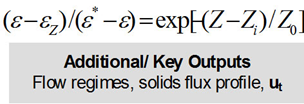
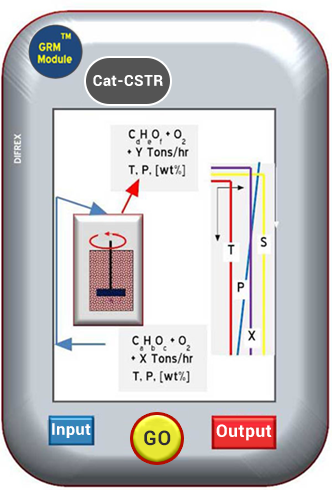 Catalytic CSTR (Cat-CSTR): This model is very useful for establishing reaction
mechanism and kinetics from data generated especially from reactors that closely simulate a
completely mixed or continuous stirred tank reactors (CSTR) such as a Berty/ spinning basket/
agitated reactor commonly used in catalyst development for gas-solid or liquid-solid catalytic
reactors. Obviously the model can also be used for the design or performance projection of any
CSTR (if needed) or mixing zone of other reactors such as an FCC and a CFB reactor.
Catalytic CSTR (Cat-CSTR): This model is very useful for establishing reaction
mechanism and kinetics from data generated especially from reactors that closely simulate a
completely mixed or continuous stirred tank reactors (CSTR) such as a Berty/ spinning basket/
agitated reactor commonly used in catalyst development for gas-solid or liquid-solid catalytic
reactors. Obviously the model can also be used for the design or performance projection of any
CSTR (if needed) or mixing zone of other reactors such as an FCC and a CFB reactor.
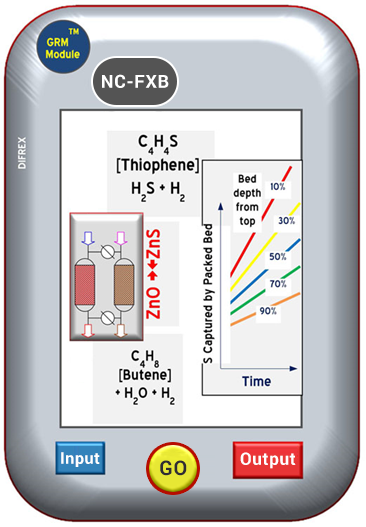 Non-Catalytic Fixed Bed Reactor (NC-FXB): For any solid-gas non-catalytic/ or
mixed (catalytic + non-catalytic) reaction, such as sulfur or mercury adsorption by
a packed bed of adsorbent, this model provides complete mapping of the
unsteady-state profiles, i.e., axial profiles of solids and gas
concentrations and conversions as a function of time. This allows one to plot breakthrough curves for gas adsorption or any other
reaction system that are critical for the design and optimal operation of a dual-bed
Adsorber-Regenerator or once-through Adsorber. The model obviously also
applies to the reverse (Desorber or Regenerator) process helping one achieve the
optimum design of an Adsorber-Regenerator system. The model can be
easily extended to cover a liquid-solid Adsorber-Regenerator system.
Non-Catalytic Fixed Bed Reactor (NC-FXB): For any solid-gas non-catalytic/ or
mixed (catalytic + non-catalytic) reaction, such as sulfur or mercury adsorption by
a packed bed of adsorbent, this model provides complete mapping of the
unsteady-state profiles, i.e., axial profiles of solids and gas
concentrations and conversions as a function of time. This allows one to plot breakthrough curves for gas adsorption or any other
reaction system that are critical for the design and optimal operation of a dual-bed
Adsorber-Regenerator or once-through Adsorber. The model obviously also
applies to the reverse (Desorber or Regenerator) process helping one achieve the
optimum design of an Adsorber-Regenerator system. The model can be
easily extended to cover a liquid-solid Adsorber-Regenerator system.
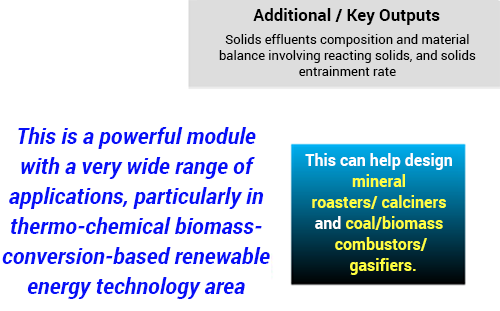
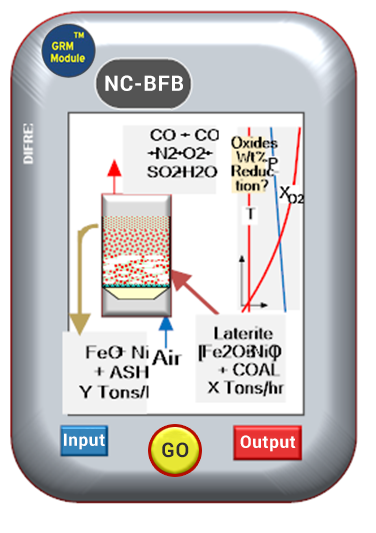 Non-Catalytic Bubbling/Turbulent Fluidized Bed Reactor (NC-BFB): Additional
output of this model is applicable to minerals processing like roasting and/or calcining and for
combustion, incineration, pyrolysis and/or gasification of solids such as coal and biomass and
includes axial profiles of composition, production/consumption and Elutriation rates of reacting
and product solids.
Non-Catalytic Bubbling/Turbulent Fluidized Bed Reactor (NC-BFB): Additional
output of this model is applicable to minerals processing like roasting and/or calcining and for
combustion, incineration, pyrolysis and/or gasification of solids such as coal and biomass and
includes axial profiles of composition, production/consumption and Elutriation rates of reacting
and product solids.
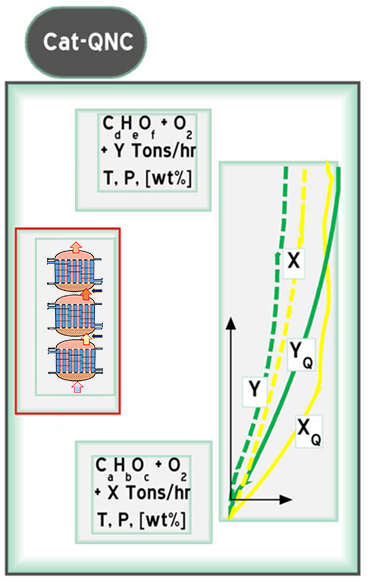
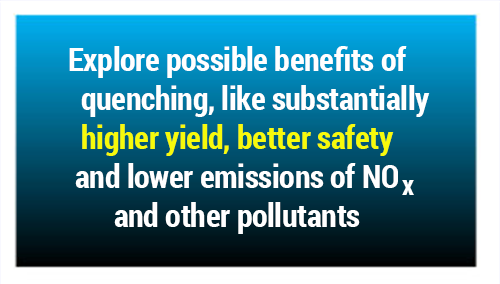
Catalytic Quench Reactor (Cat-QNC): Inter-stage composition of quench gas (part
of feed gas or oxidant as example), temperature, number of stages and injection levels can be
varied in this module to determine possible effects of these additional design/ operating
variables of a reactor.
;
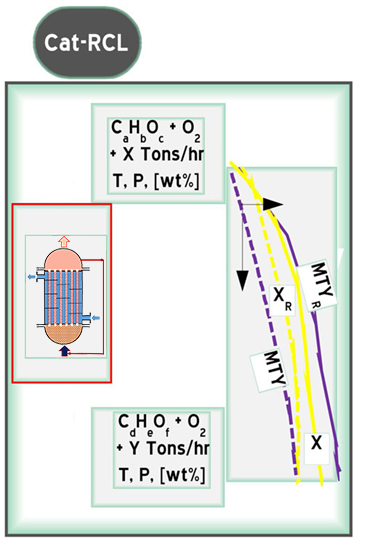
Catalytic Recycle Reactor (Cat-RCL): This option allows one to obtain the
potential benefits of a catalytic recycle reactor with only one additional input in the feed –
the recycle ratio.
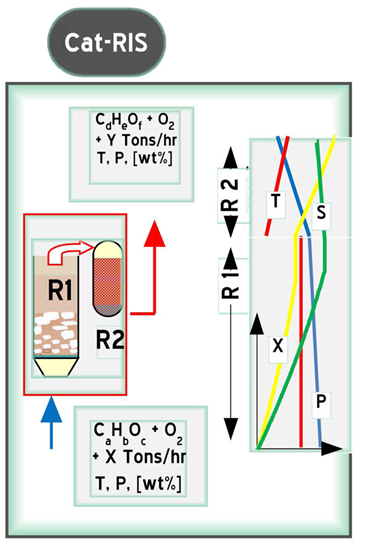
Catalytic Hybrid/ Reactors-in-Series (Cat-RIS): This module allows one to
determine the performance characteristics of a number of catalytic reactors in series (Cat-RIS)
operating in same or different design and/or operating conditions, such as BFB → FXB or
CSTR → CFB → BFB (to simulate an FCC
reactor)
, with products (or part of it) from one reactor acting as feed to the next reactor.
Optimization of this Cat-RIS system may lead not only to significant improvements in both
product yield and quality but also to reduction in overall reactor cost. This module comes handy
for that polishing reactor design that you may have in mind or for
low per-pass conversion reactors.
More …. : Each GRM™
Module is applicable to a particular reactor configuration. More modules
such as moving bed reactor and slurry bubble column
reactor are under development. Also planned is future development of
Syngas generator design based on specific biomass feed stocks such as wood-chips, MSW and
agricultural wastes. The GRM™ Package includes all the current
modules and will be periodically updated with the addition of new modules/ features or continued
improvements in many areas that include:
1) improved parameter estimation routine
2) faster/ automated determination of reaction mechanism and kinetics
3) improved/ faster source code
4) database coverage and extension
________________________________
* Reactor models for sale to be released soon.
Reactor Design by Process Engineer focuses on selecting the right reactor type, optimizing operating conditions, improving conversion, and ensuring safe, efficient, and scalable reactor performance using simulation and engineering analysis.
Difrex reactor design solutions are useful for process engineers, catalyst developers, technology providers, researchers, EPC companies, and entrepreneurs working on chemical process development.
Yes. Reactor design software predicts reactor performance under different operating conditions, helping optimize designs and reduce scale-up risks before commercial deployment.